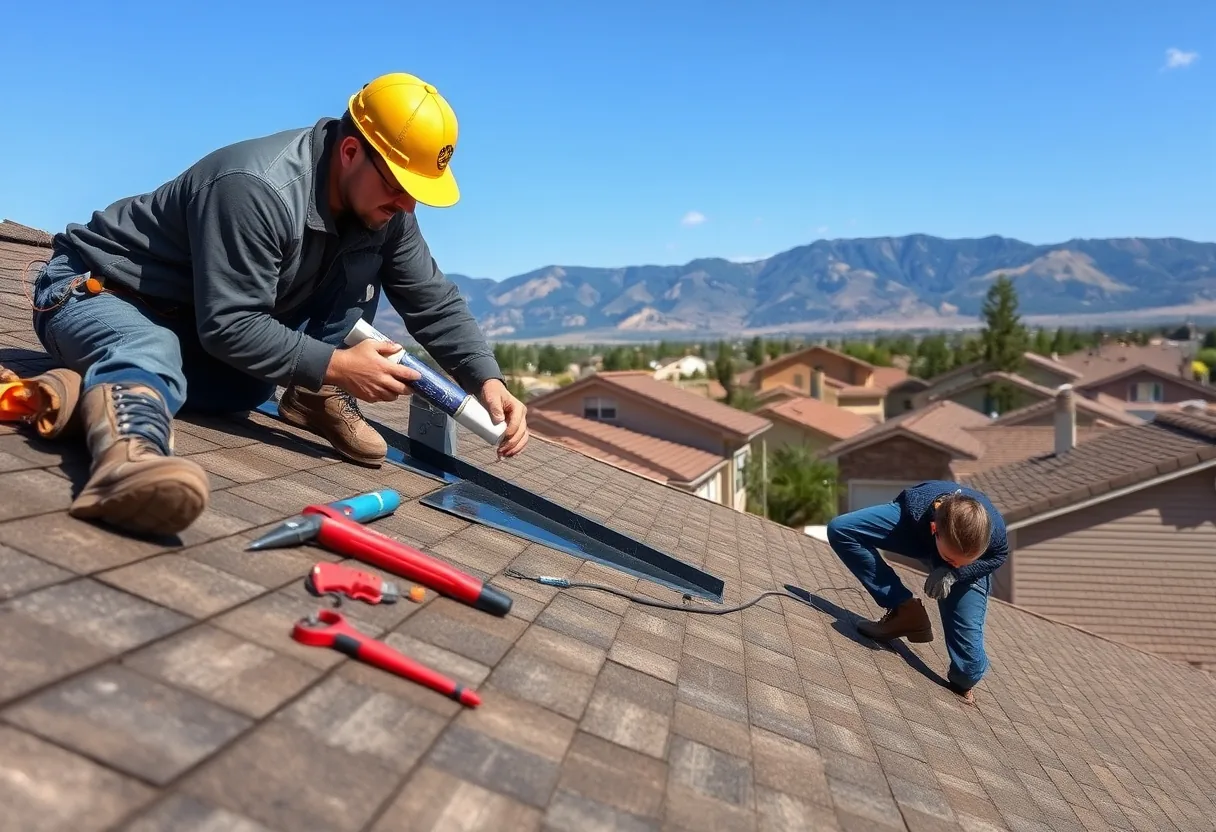
Common Roof Problems We See in Colorado Springs
Roofs on the Front Range take a beating that flatland roofs never see. Intense high-altitude sun, wild temperature swings between a sunny afternoon and a hard overnight freeze, wind-driven rain, and the occasional hailstorm all work against the same handful of weak points. Most repairs we run trace back to a short list of usual suspects.
- Active leaks — water staining a ceiling, drips in the attic, or dark streaks on interior walls after a storm
- Missing or cracked shingles — blown off by Palmer Divide winds or split by years of UV and thermal cycling
- Flashing failures — the metal around chimneys, skylights, valleys and sidewalls lifts, rusts or pulls loose
- Ice dams and freeze-thaw damage — meltwater refreezes at the eaves and backs up under the shingles
- Cracked pipe boots — the rubber collars around plumbing vents dry out and split, one of the single most common leak sources here
- Granule loss — bald spots and grit in the gutters signal shingles giving up their protective surface
- Ponding water — flat and low-slope sections that never fully drain and slowly break down the membrane
The tricky part is that where water shows up inside almost never lines up with where it enters the roof. Water travels along the deck, down rafters, and across the ceiling before it drips. That is why a real diagnosis matters more than a quick patch over the nearest stain.
Repair or Replace? How to Decide
Not every problem roof needs to come off. The honest answer depends on three things: the age of the roof, the extent of the damage, and whether you are fighting recurring leaks in the same areas. We will always tell you when a repair is the smart, cost-effective call — and when patching good money onto a failing roof is only delaying the inevitable.
- Repair makes sense when the roof is mid-life, the damage is localized, and the rest of the field is sound
- Replacement makes sense when shingles are near the end of their service life, damage is widespread, or you have chased the same leak two or three times
- Storm damage can tip the scales either way — a hail-bruised roof sometimes qualifies for a full replacement through your storm claim
If the numbers point toward starting fresh, we lay out your options for a full roof replacement with no pressure. Either way you get a straight recommendation, not a sales pitch.
Our Roof Repair Process
A lasting repair is a process, not a tube of caulk. Every job we take on follows the same disciplined steps so nothing gets missed and the fix actually holds through the next winter.
- Inspection — we walk the entire roof, not just the reported spot, and check the attic where we can access it
- Leak diagnosis — we trace water back to its true entry point, which is often feet away from the interior stain
- Material matching — we source shingles, flashing and boots that match your existing roof in profile and color
- The repair — we make the fix properly: replace failed components, reseat flashing, and fasten to code
- Verification — we test the repaired area and confirm the roof sheds water the way it should before we call it done
We fix the cause, not the symptom
A patch over a stain buys a few weeks. Finding where water actually enters — a lifted flashing, a split boot, a popped fastener — is what keeps your ceiling dry for years. That diagnosis is the part cheap patch jobs skip, and it is the part that saves you from paying twice.
Emergency Leak Repair and Storm Tarping
When a storm tears open your roof and water is coming in, you cannot wait a week. We respond fast to active leaks across Colorado Springs, Monument, Falcon and the surrounding foothills — stopping the water, protecting your attic and drywall, and buying time for a permanent repair.
Our emergency crews carry heavy-duty tarps and can dry-in an exposed section the same day in most cases. That temporary barrier keeps the next round of weather out while we plan the real fix and, when hail or wind is involved, help you document the damage for your storm claim.
If the culprit was a recent hailstorm or a wind event, start with our storm & hail damage service — we know how to spot the bruising and lifted shingles that adjusters look for, and we walk the claim with you from inspection to repair.
Why Altitude and Freeze-Thaw Wreck Colorado Roofs
Colorado Springs sits above 6,000 feet, and that elevation changes everything about how a roof ages. The thinner atmosphere lets far more ultraviolet light reach your shingles, sealants and rubber components. UV is what dries out and cracks the pipe boots, embrittles caulk and sealant beads, and cooks the flexibility out of flashing gaskets years earlier than they would fail at sea level.
Then comes freeze-thaw. Front Range roofs cycle above and below freezing hundreds of times a season — sun-warmed by day, hard-frozen by night. Any water that has worked its way into a tiny crack expands as it freezes, prying the gap wider with every cycle. A hairline split in a pipe boot in October becomes an open channel by March.
This is why we treat quick repair as urgent rather than optional. Once water gets past the shingles, it soaks the wood decking underneath. Wet decking rots, loses its grip on nails, and grows mold — turning a two-hundred-dollar boot replacement into a torn-off section of roof and a stained, sagging ceiling below.
Common Roof Repairs and Rough Cost Ranges
Every roof is different, so treat these as ballpark estimates, not quotes. The final price depends on roof pitch, height, access, material and how far the damage has spread. We give you a firm, written number after we actually look at the roof — never a guess over the phone.
| Repair | Typical Range | Notes |
|---|---|---|
| Cracked pipe boot replacement | $150 - $450 | One of the most common and preventable leaks |
| Flashing repair (chimney, skylight, wall) | $300 - $1,200 | Depends on length and accessibility |
| Replace missing or damaged shingles | $250 - $900 | Small section; matching materials matters |
| Valley or ridge repair | $400 - $1,500 | High-stress areas that shed the most water |
| Emergency tarping / dry-in | $300 - $800 | Temporary protection after storm damage |
| Small low-slope membrane patch | $350 - $1,200 | Ponding and seam failures on flat sections |
Bigger repair on the horizon? Financing is available so a surprise leak does not blow up your month. See our financing & claims assistance options — and if a storm caused the damage, we can often coordinate the work with your insurance claim.
Why a Small Leak Is Urgent at Altitude
At 6,000-plus feet, roofs age faster and small problems compound quicker than most homeowners expect. A leak the size of a pencil tip can dump gallons into your attic over a single wet week. Caught early, it is a same-day fix. Ignored through one freeze-thaw winter, it becomes rotted decking, ruined insulation, stained drywall and sometimes mold — a repair many times the original cost.
The cheapest roof is the one you maintain. Twice-yearly checkups — ideally spring and fall — catch dried-out boots, lifted flashing and wind-loosened shingles before water ever finds them. Our roof inspections are thorough and documented, and clean, free-flowing gutters keep meltwater moving away from your eaves instead of backing up under the shingles as ice dams.
See a stain? Do not wait for spring.
That brown ring on the ceiling means water is already inside and the decking is already getting wet. Every freeze-thaw cycle makes it worse. Get a set of eyes on it now — book a free inspection and we will tell you exactly what you are dealing with and what it takes to fix it.
Get Your Roof Repaired the Right Way
Pikes Peak Roofing repairs roofs across Colorado Springs and the surrounding Pikes Peak region — asphalt shingle, metal, tile and low-slope. We diagnose the real problem, match your materials, and stand behind the work.
Book a free inspection or call 844-967-5247 to talk to a local roofer who knows exactly what altitude, wind and hail do to a Front Range roof. If water is coming in right now, tell us up front and we will get an emergency crew moving.