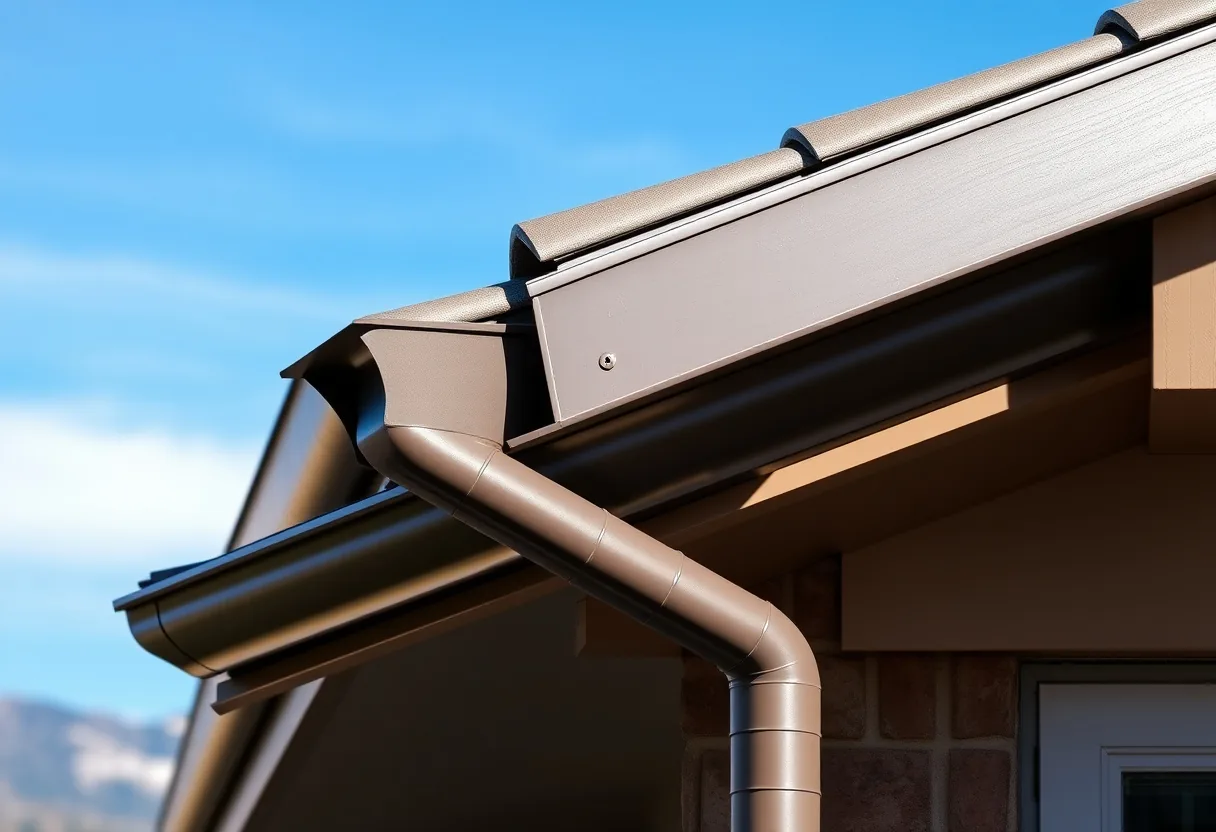
Why Gutters Matter So Much in Colorado Springs
Colorado Springs does not get a lot of rain, and that is exactly why gutters get neglected here. But the water we do get arrives in two brutal forms: spring snowmelt trickling off the roof for weeks, and summer monsoon downpours that dump an inch in twenty minutes. Both of those need somewhere to go, and if your gutters are missing, undersized, or clogged, that somewhere is the base of your foundation.
The soil under most Front Range homes is the real problem. Expansive clay soils swell when they get wet and shrink when they dry, and that constant heave is what cracks foundation walls, sticks doors, and opens gaps in basement corners. Concentrated roof runoff pooling next to the house is the fastest way to trigger it. Good gutters exist to keep that water moving away from the structure, not soaking into the ground beside it.
- Foundation protection — channels snowmelt and downpours away from clay soils that swell, shift, and crack concrete
- Basement dryness — stops water from ponding at grade and seeping through walls and cove joints
- Ice dam defense — paired with proper attic ventilation, reduces the freeze-thaw buildup that tears gutters loose
- Siding and fascia life — keeps sheeting water off wood trim, stucco, and paint that otherwise rots and stains
If you have ever watched a waterfall pour off your roofline during a July storm, you have watched your foundation take a hit. That is the problem we solve, and it pairs directly with the roof repair and roof inspections work that keeps the whole system tight.
The Gutter Systems We Install
We fabricate seamless aluminum gutters on-site from a coil-fed machine, cutting each run to the exact length of your eave. Seamless means no soldered joints every ten feet to leak, clog, and split apart in a freeze — the only seams are at inside and outside corners. Aluminum will not rust, holds paint for decades, and comes in dozens of colors to match fascia and trim.
5-inch K-style is the standard residential profile and handles most Colorado Springs homes. On steep pitches, large roof planes, or foothill houses under heavy tree cover, we step up to 6-inch K-style, which moves roughly 40 percent more water and pairs with larger 3x4-inch downspouts that clog far less than the standard 2x3. For historic and higher-end homes we also fabricate half-round profiles in aluminum or copper.
- Downspouts — 2x3 and oversized 3x4 outlets placed to actually carry your roof's volume, not just to look symmetrical
- Gutter guards / leaf protection — micro-mesh and screen systems that keep pine needles and debris out of the trough
- Heat cable — self-regulating de-icing cable run in the gutter and downspout to keep meltwater flowing in a freeze
- Extensions and splash blocks — discharge accessories that push water the critical 5-plus feet away from the wall
Downspout placement beats gutter size every time
The most common failure we fix is not undersized gutter — it is too few downspouts, spaced too far apart. Water backs up, overflows the front lip, and pours right where you least want it. Proper pitch (about a quarter inch of fall per ten feet) and a downspout roughly every 30 to 40 feet matter more than upsizing the trough. We design the whole system, not just the metal.
Hail and Your Gutters: A Damage Warning Sign
Colorado Springs sits in the heart of Hail Alley, and your gutters are one of the easiest places to read a storm's severity from the ground. Dented, dinged, or dimpled gutters and downspouts are a leading indicator of hail damage — if the aluminum took hits hard enough to dent, your shingles almost certainly took hits too, even when the roof looks fine from the driveway.
This matters because hail damage to a roof is often invisible to an untrained eye but very visible to an adjuster. When we spot fresh spatter marks and dents on gutter aprons, hoods, and downspouts, we know to look closer at the shingles, vents, and flashing. That is why we tie gutter work directly to our storm & hail damage service and a full roof inspection.
If a storm has come through, do not wait. We provide free documented inspections, and we can assist with the insurance claim process by photographing and reporting the hail evidence on your gutters and roof so nothing gets missed. We do not sell insurance — we make sure the damage is properly captured and repaired. Schedule a free inspection and we will read the whole system for you.
Installation, Replacement, Repair & Cleaning
Gutters are a full-lifecycle service, and we handle every stage of it. New installation on additions and new builds, full replacement of tired or storm-battered systems, targeted repairs to sagging runs and leaking corners, and seasonal cleaning to keep everything flowing before winter and after the trees drop.
- Installation — laser-set pitch, hidden hangers screwed into solid fascia, and downspouts routed to daylight away from the foundation
- Replacement — tear-off of failed sectional gutter and re-hang in one seamless run, ideally bundled with a roof project
- Repair — re-pitching sagging sections, resealing corners, refastening pulled hangers, and swapping crushed downspouts
- Cleaning — clearing needles, leaves, and grit from troughs and flushing downspouts so meltwater never backs up
Most gutter failures we see are not the metal wearing out — they are pitch and fastening problems. A gutter that has lost its slope holds standing water, grows heavy with sediment, and eventually pulls its hangers out of the fascia. We reset the fall, anchor into sound wood, and make sure water actually reaches the downspouts instead of pooling in the middle of the run.
Colorado Challenges: Ice Dams, Snow Load & Pine Needles
The Pikes Peak region puts gutters through a punishing freeze-thaw cycle. Sunny days melt the snow on your roof, cold nights refreeze it at the eave, and the buildup becomes an ice dam — a ridge of ice that traps meltwater behind it and forces it up under the shingles. Heavy ice also loads the gutter with hundreds of pounds it was never meant to hold, tearing it away from the fascia.
We fight this on two fronts: self-regulating heat cable run through the gutter and downspout to keep a drainage channel open, and gutter systems anchored with enough hidden hangers to survive the load. Ice dams ultimately come from heat escaping into the attic, so the real fix often pairs gutter work with the ventilation and repair issues we catch during a roof inspection.
In the foothills — Black Forest, Woodland Park, and the pine-heavy neighborhoods west of town — the bigger enemy is organic debris. Pine needles are the worst offender: they slip through cheap screens, mat into a felt-like clog, and hold water that freezes solid. Homes under heavy tree canopy are exactly where micro-mesh gutter guards and a larger 6-inch profile with 3x4 downspouts pay for themselves.
Snow load is a structural load
A ten-foot run of gutter packed with ice and wet snow can carry several hundred pounds. Sectional gutters with spike-and-ferrule fasteners simply cannot hold that in a Front Range winter — they pull loose, bend, and dump water at the foundation. Seamless aluminum on properly spaced hidden hangers is not a luxury here; it is what survives the season.
Gutter Options & Rough Cost
Every home is different — roof size, number of stories, tree cover, and how many downspouts the layout needs all move the number. The ranges below are rough estimates to help you plan, not a quote. The best value is almost always bundling gutters with a roof replacement, when access, crew, and disposal are already staged.
| Option | Best For / Benefit | Rough Estimate |
|---|---|---|
| 5" seamless aluminum | Standard homes — no-rust, no leaky joints, dozens of colors | $8-$14 per linear foot |
| 6" seamless aluminum | Steep or large roofs, foothill homes — ~40% more capacity | $12-$20 per linear foot |
| Micro-mesh gutter guards | Pine-needle and leaf-heavy lots — far less cleaning | $7-$14 per linear foot |
| Heat cable (de-icing) | Ice-dam-prone eaves and valleys — keeps meltwater flowing | $8-$16 per linear foot |
| Half-round aluminum or copper | Historic and high-end homes — architectural look | $18-$40+ per linear foot |
Bundle the gutters with a residential roof replacement and the incremental cost drops, because we are already on your roof and the tear-off, staging, and cleanup are handled once. It is the cleanest way to get a matched, warrantied water-management system in a single project.
Get a Free Gutter Inspection
Whether your gutters are overflowing every storm, pulling away from the fascia, or freshly dented from the last hailstorm, we will walk the whole system and tell you straight what it needs — repair, cleaning, guards, or full seamless replacement. No pressure, no upsell on metal you do not need.
We serve Colorado Springs, Monument, Falcon, Fountain, Black Forest, Woodland Park, and the wider Pikes Peak region. Schedule your free inspection or call 844-967-5247 and we will get you on the calendar — and if a storm just rolled through, we will document any hail evidence for your claim while we are up there.